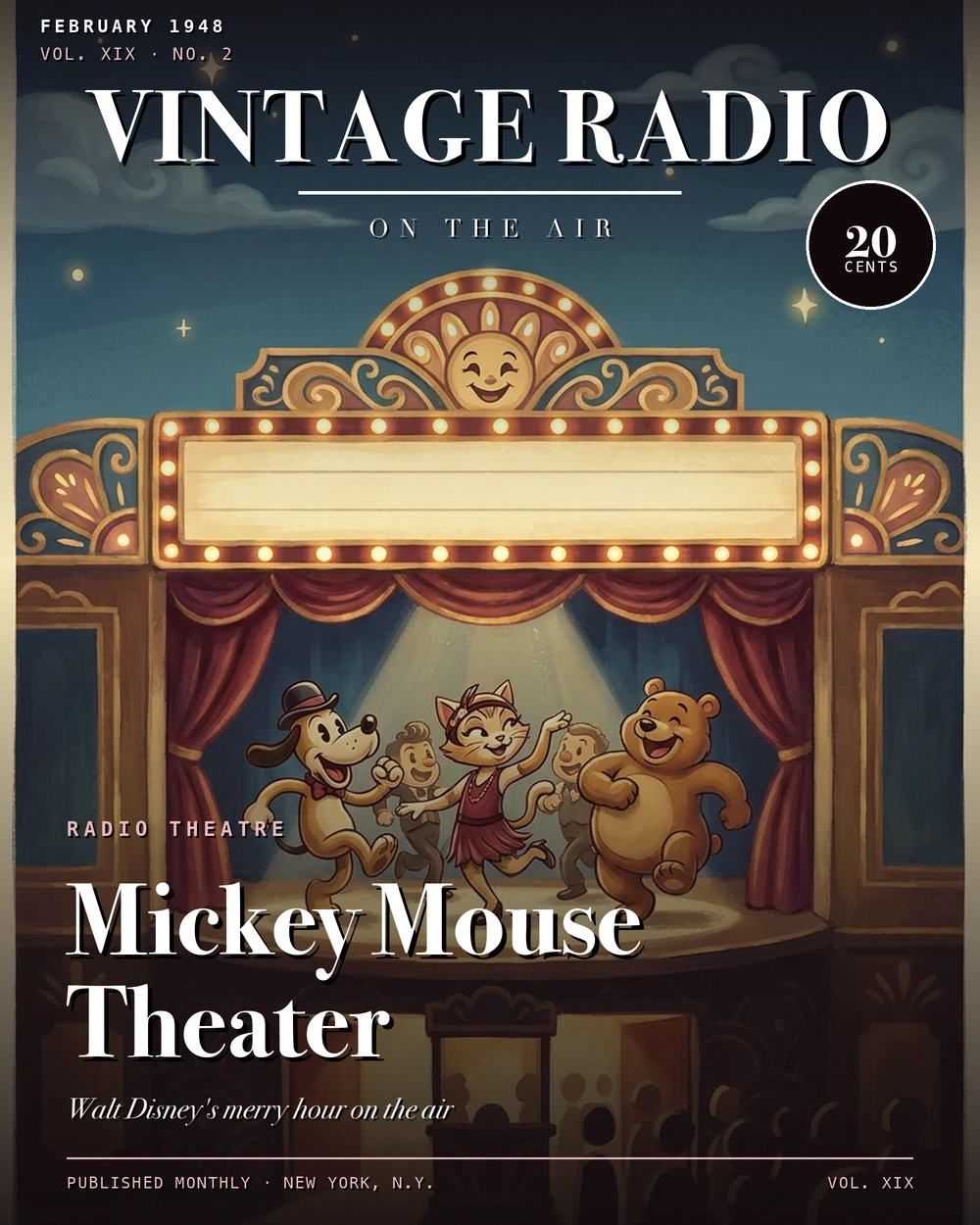
Mickey Mouse Theater
The Only Time Disney Came to Radio
Walt Disney's characters made exactly one run at network radio, and it lasted just twenty Sunday afternoons in 1938. Mickey Mouse Theater aired on NBC from January 2 to May 21 of that year, sponsored by Pepsodent toothpaste. The slot itself had history: Pepsodent had previously backed Amos 'n' Andy in that Sunday 5:30 spot, and when Amos 'n' Andy switched to Campbell Soup and moved to a different timeslot, Pepsodent went looking for a new attraction. Disney historian Jim Korkis documented a photo of Charles Correll and Freeman Gosden — Amos and Andy themselves — symbolically handing over their "lucky radio horseshoe" to Walt Disney at the changeover. Pepsodent's weekly sponsorship budget of $10,000 to $12,000 was reportedly a significant factor in convincing Disney to commit to the project, after earlier approaches from Lever Brothers and Lucky Strike had each come close but hadn't closed.
The format the show eventually used wasn't the first idea on the table. In 1937, somebody pitched a talk-show concept in which Mickey Mouse would interview celebrity guests. That concept was scrapped in September 1937, and the writers regrouped around something that suited the Disney characters much better: folk tales, nursery rhymes, and fairy tales. Each episode used the Snow White Magic Mirror as a narrative device to drop Mickey and company into a different adventure setting — one week Robin Hood, another Ali Baba, another King Neptune's undersea kingdom. The device gave the writers fresh material every Sunday without having to invent new premises from scratch.
The Cast Behind the Characters
Walt Disney himself hosted the show and voiced Mickey Mouse — but only for the first three episodes. Post-production and promotional work for Snow White and the Seven Dwarfs pulled him away, and starting with the fourth episode, a comedian named Joe Twerp took over the role. Twerp, born Escott Brandon Boyes in West Allis, Wisconsin, had a style built on excitability, stuttering, and word-confusion. He had actually been considered for the voice of Doc in Snow White before being passed over for Roy Atwell — and then ended up voicing Doc on this radio program anyway. When Disney couldn't appear for his hosting duties either, announcer John "Bud" Hiestand stepped in to impersonate him. Hiestand also voiced the Magic Mirror, the recurring narrative gateway through the whole run.
Clarence Nash reprised Donald Duck from the cartoons, and Thelma Boardman handled Minnie Mouse. Goofy was voiced by Stuart Buchanan — a somewhat unusual choice, since Pinto Colvig had been the regular Goofy in Disney animated shorts, but Colvig had left the studio before the show began. Buchanan was the dialogue and casting director at Disney Studios, held a Ph.D. from Harvard, and had previously taught English and coached basketball at West Virginia University. He had also supplied the voice of the Huntsman in Snow White. Florence Gill reprised her role as Clara Cluck, a character she had originated in the 1934 Silly Symphony short "Orphan's Benefit"; Gill was a British actress trained at the London Royal Academy of Music who had originally aimed for a career in grand opera.
The supporting cast included some performers who would later become well-known for entirely different things. Hans Conried played the Pied Piper in the March 13 episode, years before he would voice Captain Hook in Peter Pan (1953). Bea Benaderet appeared as Miriam the Mermaid in "King Neptune." Cliff Arquette voiced Old MacDonald in the final episode — he later became famous as Charley Weaver on Hollywood Squares, and is the grandfather of actors Patricia, Rosanna, and David Arquette. Billy Bletcher, the voice of Pete in Disney animated cartoons, appeared in multiple episodes, and Walter Tetley was among the supporting performers as well.
And then there was Mel Blanc, around 29 years old, well before his contract with Warner Bros. Blanc didn't voice any established Disney character on the show. His recurring bit was a character who became so excited that he couldn't stop hiccupping. Historian Keith Scott credits that hiccupping bit as the direct link that led Disney to cast Blanc as Gideon the Cat in the 1940 feature Pinocchio — and in a turn that fits neatly with his contribution here, nearly all of Gideon's dialogue was cut from the finished film, leaving only a single hiccup.
The Sound of the Thing
The music ran through three distinct units. The Felix Mills Orchestra provided the main backing, with what was described at the time as a proper cartoon sound. Then there was Donald Duck's Webfoot Sextet — also called Donald Duck's Swing Band — a novelty ensemble built around unconventional instruments: a meat grinder, an auto horn, a Bob Burns-style bazooka, and something called a "syrup-cruet hurdy gurdy," which Mills and soundman Hal Reese operated together and could reportedly coax actual music out of. The third unit was the Minnie Mouse Woodland Choir, a twelve-member all-female vocal group, with an eight-member male choir joining in on some episodes. The opening theme was "Who's Afraid of the Big Bad Wolf?" and the closing was "Heigh-Ho" from Snow White.
The show was performed before a live studio audience at the Disney Little Theater on the RKO lot. The January 9 episode, "Snow White Day," featured songs directly from the Snow White film — "I'm Wishing," "One Song," "Someday My Prince Will Come" — and closed with an instrumental of "With a Smile and a Song." That episode aired a week before Snow White and the Seven Dwarfs opened at Radio City Music Hall on January 13, 1938, ahead of its general North American release on February 4. The radio show and the film were timed to support each other.
How It Was Received
Not every critic was convinced. Aaron Stein, writing in the New York Post at the time, argued that Disney's characters lost their essential appeal without the accompanying visuals, calling their audio presentation "disembodied sound effects." That was a reasonable worry — these were characters whose expressiveness lived in movement and image — though the show drew enough of an audience that Pepsodent, after an initial contract for 13 episodes, renewed for an additional 7. The full run reached 20 episodes before ending on May 21, 1938, with titles ranging across fairy-tale and adventure settings: Cinderella, Sleeping Beauty, Long John Silver, King Arthur, William Tell, and Ali Baba, among others. The Felix Mills estate later donated Mills's original transcription discs to the Pacific Pioneer Broadcasters in California, which is the source for any surviving audio from the run.